Overview
For Baramas, publishing a blog article was followed by more writing. Someone still needed to prepare separate posts for LinkedIn, Facebook, and X, formerly Twitter.
Stock questions and orders brought a different set of repetitive tasks. Team members had to open Google Sheets, find product information, update records, and prepare confirmations.
Red Star Technologies built two Make.com workflows to handle these processes. The first turns WordPress articles into social drafts for review. The second gives the team an AI assistant in Slack for inventory and order requests. Both workflows are completed and operating in Baramas’s environment.
Initial Challenge
1. Preparing Social Posts After Each Article
Every new blog post needed to be adapted for several platforms.
The team had to revisit the article, select its main points, and write versions with different lengths and tones. On busy weeks, that additional work could delay social promotion or leave it unfinished.
2. Keeping Editorial Approval in the Process
Baramas wanted help preparing content while retaining control over publication.
Generated drafts needed a shared destination where the team could check the wording, make changes, and organize the posts before publishing.
3. Accessing Inventory Information from Slack
Team conversations happened in Slack, but stock records lived in Google Sheets.
Answering a product question required someone to leave the conversation, locate the correct spreadsheet, search for the item, and report back.
4. Coordinating Order Records and Confirmations
Order handling involved several related actions: recording the order, adjusting stock, and sending a confirmation.
Completing those actions separately meant repeated manual updates across applications.
Background
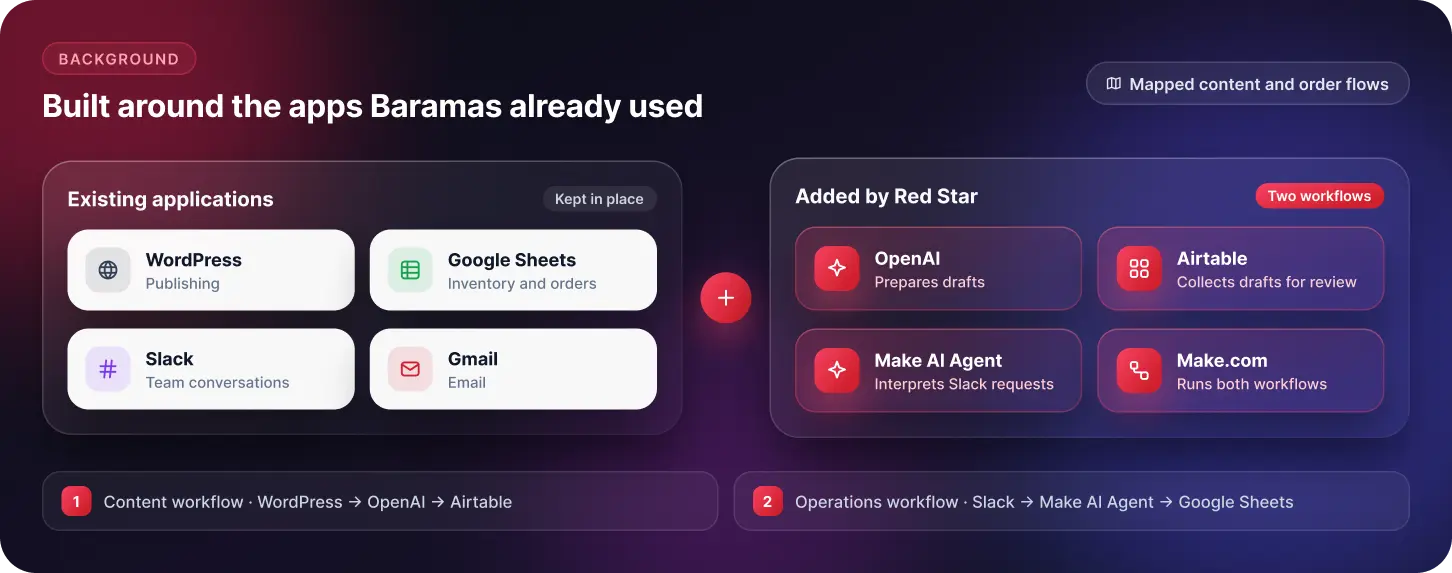
Baramas is led by Sean Rolle and operates with a small team. It publishes through WordPress, maintains inventory and order records in Google Sheets, communicates in Slack, and uses Gmail for email.
We mapped how content and orders moved through the business, then developed two workflows around these existing applications.
The content workflow uses OpenAI to prepare drafts and Airtable to collect them for review. The operational workflow uses a Make AI Agent to interpret Slack requests and select tools connected to Google Sheets.
Solution Design and Implementation
1. Created Social Drafts from WordPress Content
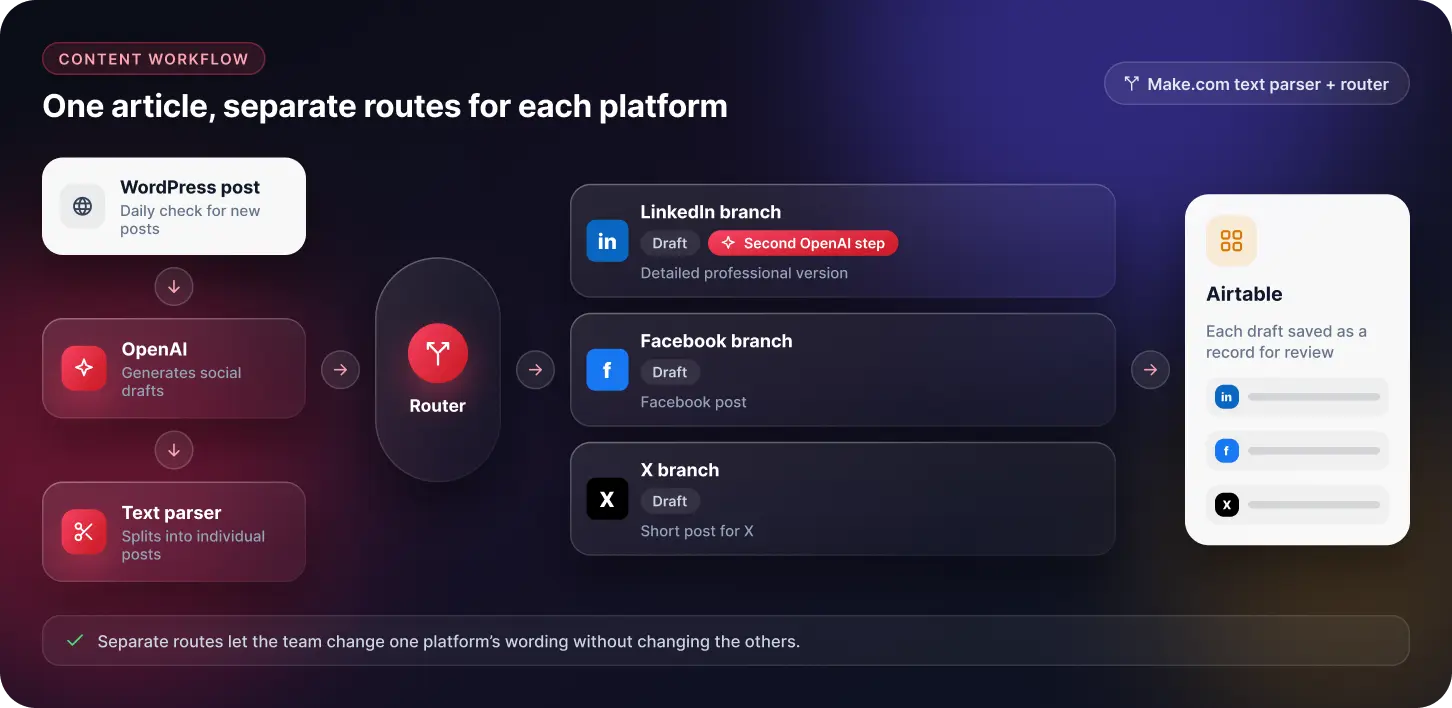
The content workflow runs a daily check for new WordPress posts.
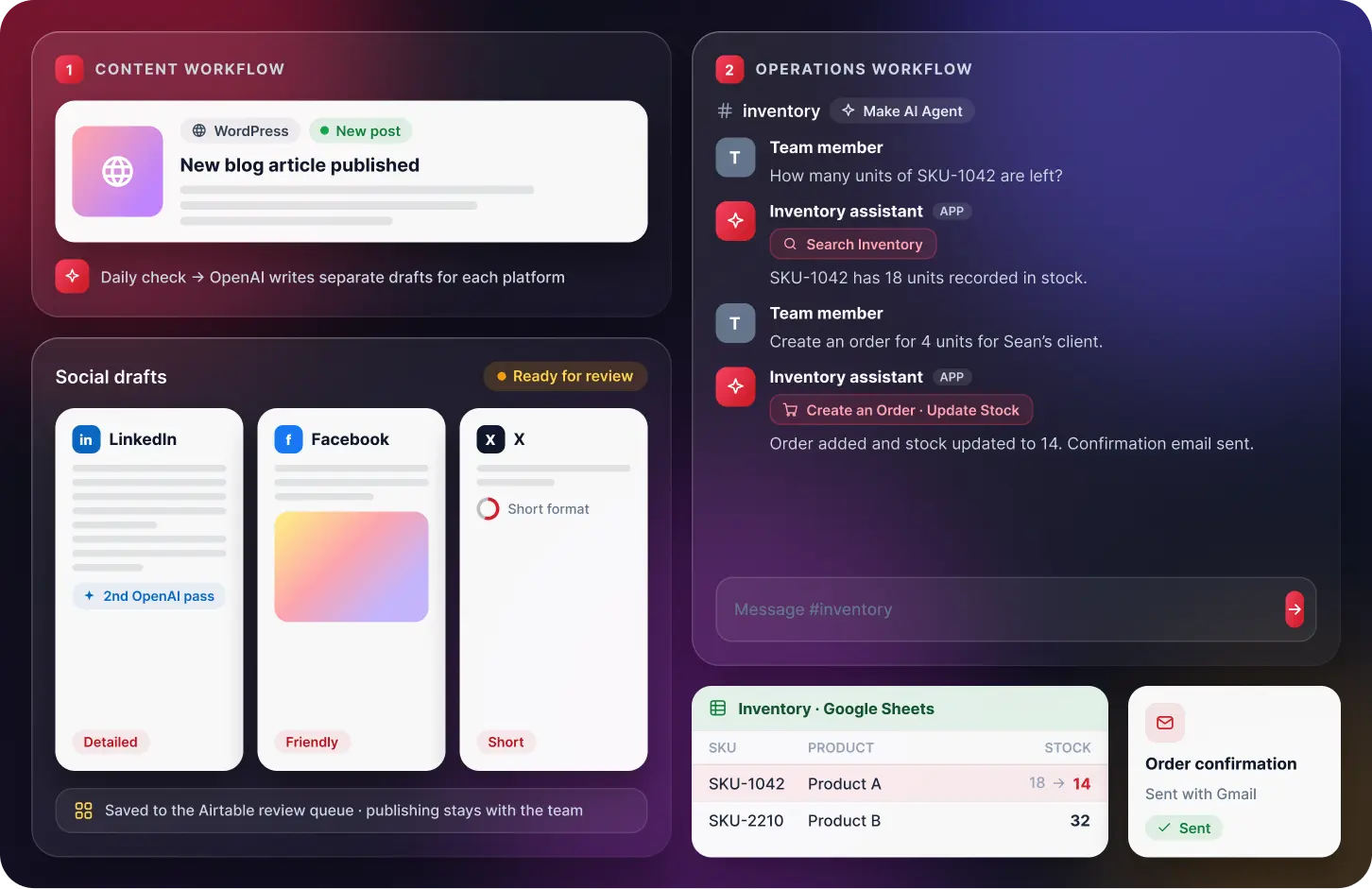
OpenAI uses each article to generate separate social drafts. This gives the team material to review without writing every platform’s post from the beginning.
The workflow prepares draft content. Publishing remains with the team.
2. Built Separate Routes for Each Platform
A text parser separates the generated response into individual posts. A router then directs each piece through the appropriate platform branch.
The LinkedIn branch includes a second OpenAI step to develop a more detailed professional version. Separate branches handle Facebook and X content.
Keeping the routes separate allows changes to one platform’s wording without changing the others.
3. Established an Airtable Review Queue
Each generated draft is saved as an Airtable record.
The team can review, edit, and organize the content in one table before publication. This creates a defined handoff from automated drafting to editorial approval.
4. Connected Slack Requests with Google Sheets
The inventory and order workflow receives Slack messages and filters out bot replies and system events.
A Make AI Agent interprets the request and selects from three tools:
- Search Inventory: Find products and retrieve recorded stock levels.
- Update Stock: Adjust quantities for sales, receipts, or other stock changes.
- Create an Order: Add an order record with its details.
These tools let the team initiate supported actions from Slack instead of opening the spreadsheet for each request.
5. Added Replies and Email Confirmations
The assistant responds in the same Slack channel after processing the request. The workflow also uses Gmail for order confirmation emails.
This connects the spreadsheet action with a response in the team’s conversation and an email record of the order.
The Results
The delivered Make.com workflow automation supports content preparation, inventory lookup, stock updates, and order administration.
| Area | Before | After Implementation |
|---|---|---|
| Social draft preparation | Write separate posts after each blog article | Generate platform-specific drafts from new WordPress posts |
| Platform adaptation | Rewrite content individually for each platform | Process drafts through separate platform branches |
| Content review | Coordinate drafts across documents and messages | Review and edit drafts in Airtable |
| Inventory lookup | Open Google Sheets and search manually | Request product and stock information through Slack |
| Stock updates | Edit spreadsheet quantities directly | Initiate updates through the assistant’s connected tool |
| Order recording | Enter order details manually | Create order records through supported Slack requests |
| Confirmations | Prepare replies and emails separately | Include Slack responses and Gmail order confirmations in the workflow |
Sean’s team now reviews social drafts in a shared review queue. Inventory and order requests can begin in Slack and connect directly with the relevant Google Sheets tools.
Lessons Learned
- Give AI-generated content a clear review destination: Airtable provides a shared place for checking and editing drafts before publication.
- Handle platform differences within separate routes: Each branch can be adjusted to suit its audience and format.
- Bring operational tools into team conversations: A Slack interface connects questions with the spreadsheet actions needed to address them.
- Define the agent’s available actions: Inventory searches, stock adjustments, and order creation each have a specific tool and purpose.
Connect Your Content and Operational Workflows
If your team repeatedly rewrites blog content or switches applications to handle stock and order requests, those processes may offer opportunities for automation.
Red Star Technologies can help develop Make.com workflows and AI assistants around your applications, content review process, and operational requirements.
Talk to Our Team About Content and Business AutomationTech Stack Summary
| COMPONENT | TECHNOLOGY |
|---|---|
| Workflow orchestration and scheduling | Make.com |
| Blog content source | WordPress |
| Social draft generation | OpenAI |
| Content separation and routing | Make.com Text Parser, Router, and filters |
| Draft storage and review | Airtable |
| Team interface | Slack |
| Request interpretation and tool selection | Make AI Agents |
| Inventory and order records | Google Sheets |
| Order confirmation emails | Gmail |
Conclusion
Baramas now has defined workflows for preparing social content and handling routine inventory and order requests. The team keeps editorial control over publishing while accessing supported spreadsheet actions through Slack.